5 -7 day delivery - within US & Canada
Worldwide delivery
Buy now. Pay later with

(available within Europe only)
5 -7 day delivery - within US & Canada
Worldwide delivery
Buy now. Pay later with
(available within Europe only)
Riding bareback sharpens your feel. Every stride, every breath, every shift of balance comes through directly into your seat, and it is one of the most effective ways to develop an independent seat and a quieter contact with your horse. Before you buy anything, though, there is one essential point to understand: when you sit directly on your horse’s back, you are very close to the spine, and the spine is not built to carry the rider’s weight directly.
That is what choosing a bareback pad really comes down to. A good pad helps protect the horse’s spine from the rider’s weight, distributes pressure, and keeps the rider stable. A poor one does none of these well, and can leave the horse uncomfortable or even sore. Before you are drawn in by colours or price, here are the criteria that genuinely matter, in order of importance.
If you were to judge a bareback pad on a single criterion, this would be it.
A horse carries the rider’s weight through the muscles on either side of the spine, not on the vertebrae themselves. The best pads are therefore built with a central channel, known as a spinal or dorsal channel, that keeps the pad lifted clear of the spine and the withers. The rider’s weight can then be spread across the muscle that is able to bear it.
The detail many people miss is that padding on its own solves nothing. A thick, plush pad with no channel still presses down on the spine. It simply does so more gently. Cushioning and clearance are two different jobs, and you need both.
This matters even more for some horses: a horse with high or prominent withers, an older horse that has lost muscle along the topline, or a horse with a sensitive back. These are exactly the horses a flat pad can dig into, concentrating pressure on the sensitive areas. For them, spine clearance is not negotiable.
A quick way to check: is there a genuine gap or channel down the centre of the pad, or is it completely flat? Is the girth designed to sit on either side of the spine, or straight over it? A girth that puts pressure directly on the backbone is a bad sign.
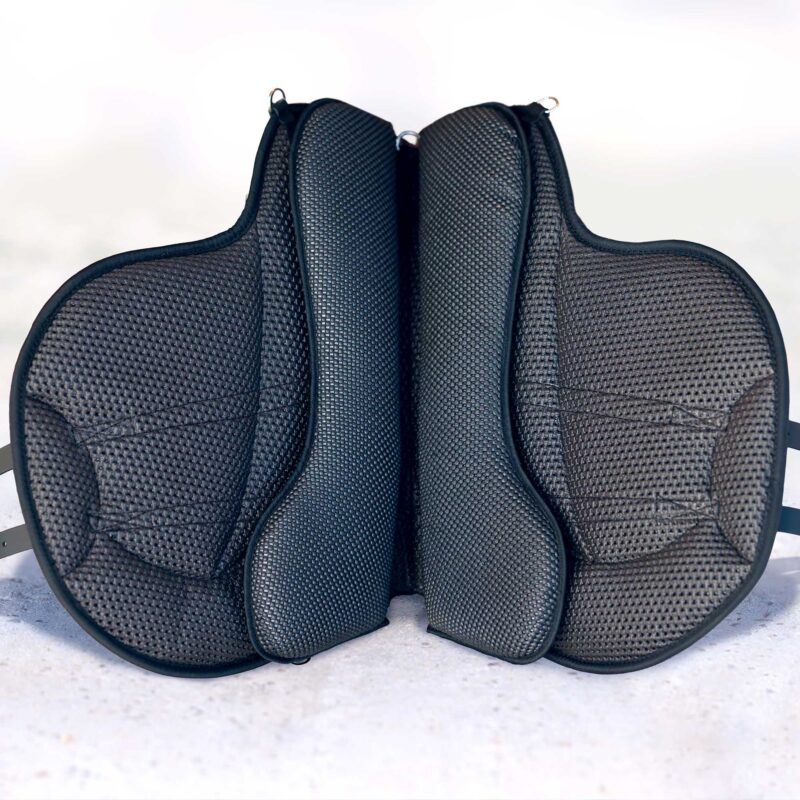
Once spine clearance is taken care of, the materials are what deserve your attention.
The top surface should help you stay stable. Suede, or a synthetic with good grip, lets you settle your seat. A slippery surface, by contrast, makes bareback riding harder than it should be and considerably less secure.
On the horse’s side, you want something soft and breathable, so as to limit rubbing and heat build-up over longer sessions. Between the two surfaces, layers of foam or shock-absorbing material help to soak up the pressure from the rider’s seat bones.
A good pad therefore comes down to three things: a grippy top surface, a soft and breathable surface against the horse, and materials tough enough to withstand regular use and repeated washing throughout the season.
There is no single best bareback pad. There is the one that suits the horse in front of you.
Start by looking at the shape of the back. High or prominent withers call for real clearance, not simply more padding. Next, consider the horse’s condition: an older horse, or one that has lost muscle over the back, will benefit far more from an anatomical design that distributes pressure than from a pad that is merely thicker. Finally, think about how you intend to use it.
Light schooling, hacking, groundwork, warming up before you tack up properly: a bareback pad can suit all of these well. It is not a saddle, however, and it will not replace a correctly fitted saddle for long or particularly demanding work.
When in doubt, always favour a pad that follows the shape of the back over the thickest model.
Size is not a matter of appearance.
Ponies need a shorter, narrower pad that sits correctly behind the withers and stays stable throughout the session. Larger horses, on the other hand, need enough length to spread the rider’s weight properly.
Since every maker has its own sizing, take the time to measure your horse and compare the measurements against the brand’s size guide rather than choosing at random. The difference between a pad designed for a pony and one made for a horse is very real.
How the pad is girthed is a question of safety and comfort, not a mere detail
The ideal is a V-shaped girthing system that holds the pad properly in place without needing to be over-tightened, while keeping the pressure points away from the spine.
What about stirrups?
You will find bareback pads sold with stirrups, but it is worth understanding why many saddle fitters advise against them. With no tree, there is nothing to anchor the stirrups securely. The stirrup leathers can then pull on soft tissue and concentrate pressure on the horse’s back.
Stirrups are also a risk for the rider: in a loss of balance, they can make it harder to get free quickly, since there is no rigid structure to stabilise or distribute the forces.
If you genuinely want to ride with stirrups, that is probably a sign that a treeless saddle, or better still a correctly fitted saddle, would suit your horse better than a bareback pad.
This topic of stirrups deserves an article of its own: we explore it in depth in our article, Bareback Pad with Stirrups: Is It Safe?
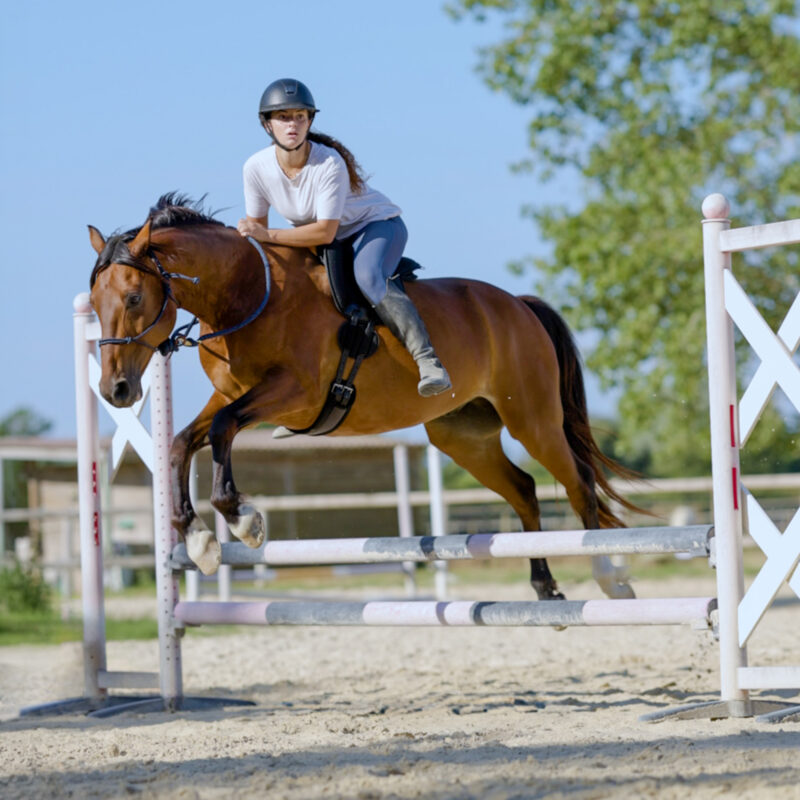
The FlyPad was designed around the criterion at the top of this list: spine clearance.
Its ergonomic dorsal channel keeps the pad clear of the spine and the withers, so that the rider’s weight is spread across the muscle on either side of the spine, where it should be borne.
Around that design, the FlyPad combines a grippy top surface, a soft and breathable lining, and a shape made to follow the horse’s back. It is handcrafted in France and Italy and comes in several sizes, for horses and ponies alike, including Minis and Shetlands.
Discover the FlyPad bareback pad to see how it is built, or browse the range to compare the available sizes.
Protect your horse’s spine, look after your own safety, and choose a pad suited to your horse’s particular shape.
Start with spine clearance, then check the other essentials: grip, materials, stability and size. Get these choices right, and bareback riding regains everything that makes it special: a closer relationship, finer feel, and a lighter, more natural experience for you and your horse alike.
General guidance for riders, not veterinary advice. If your horse has a known back problem, consult your vet or a professional specialising in back health or saddle fitting before riding



